
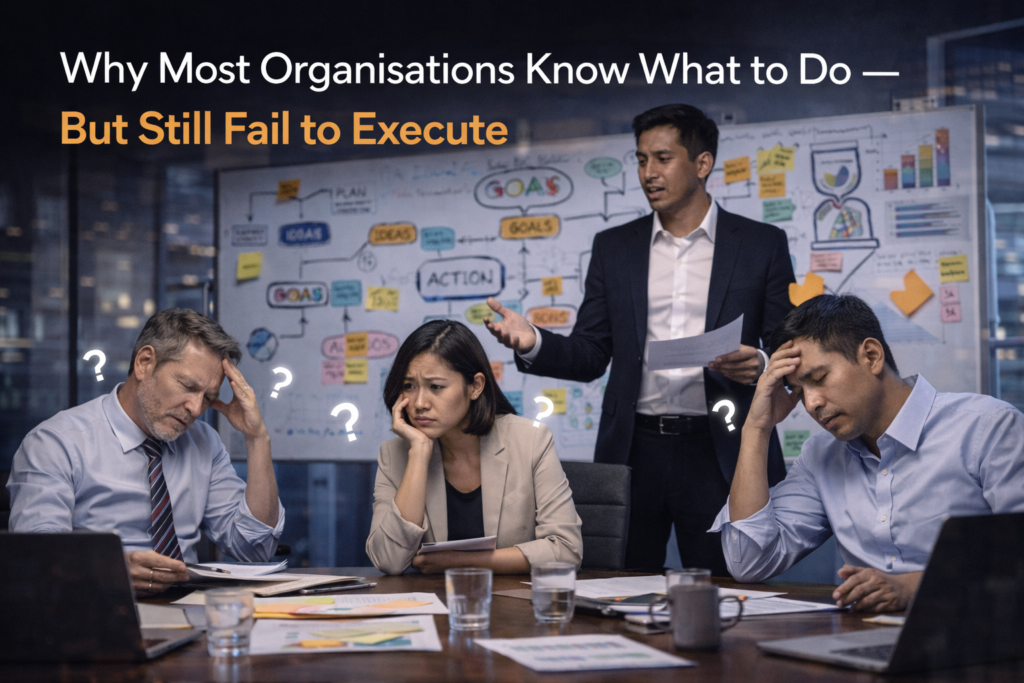
The biggest gap in Digital Transformation today is execution, not knowledge; while most organizations understand AI and digitalization, they struggle to translate that understanding into tangible results. This “Execution Gap” is the primary site where productivity, ROI, and competitiveness are lost, often because workforce capability and workflow design remain the missing links between strategy and outcomes. Ultimately, AI is a tool that amplifies execution capability rather than mere intention or knowledge, meaning that organizations that successfully close this gap will outperform their peers faster and scale with far greater effectiveness.
Introduction
Most organisations today are not lacking information.
They already know:
- AI is important
- Digital Transformation is necessary
- Workforce must evolve
They attend talks.
They read reports.
They invest in tools.
And yet…
 Results remain limited.
This leads to a critical question:
If companies already know what to do…
why are they still failing to execute?
The answer lies in a hidden but powerful problem:
The Execution Gap
The Current Problem
The Execution Gap is the space between:
Knowing what should be done
Actually doing it effectively
And this gap exists in almost every organisation.
The Symptoms of the Execution Gap
- Strategies Without Action
Plans exist—but are not implemented consistently. - Training Without Application
Employees learn—but cannot apply in real workflows. - Tools Without Integration
Systems are introduced—but not embedded into daily operations. - Data Without Decision-Making
Information is available—but not used effectively. - Initiatives Without Continuity
Projects start—but do not sustain.
The result?
Organisations feel informed
But remain ineffective.
The Strategic Framework
To close the Execution Gap, organisations must shift from knowledge-driven to execution-driven transformation.
Here are 5 key pillars:
1. Execution Clarity
Define:
- What exactly needs to change
- What actions must be taken
- Who is responsible
Clarity eliminates confusion.
2. Workflow Integration
Transformation must be embedded into:
- Daily tasks
- Operational processes
- Communication systems
3. Workforce Capability
Employees must be able to:
- Apply knowledge
- Use AI tools effectively
- Execute tasks confidently
4. Measurement & Feedback
Execution must be tracked through:
- KPIs
- Performance indicators
- Continuous feedback
5. Leadership Alignment
Leaders must:
- Drive execution
- Reinforce priorities
- Ensure consistency
Without leadership:
Execution breaks down
Deep Breakdown
Knowledge Is No Longer the Advantage
In the past:
Knowledge created advantage
Today:
Everyone has access to knowledge
The real differentiator is:
Execution capability
The Cost of the Execution Gap
Most organisations underestimate this cost.
But it includes:
- Wasted investment
- Low productivity
- Slow transformation
- Missed opportunities
Over time, this becomes:
A hidden drain on ROI
AI Amplifies Execution — Not Intention
AI does not make organisations better.
It makes them:
- Faster at what they already do
- More efficient—or more chaotic
If execution is weak:
AI increases inefficiency
If execution is strong:
AI accelerates success
Strategic / Business Implications
For SMEs
SMEs often know what to do—but struggle to implement.
Closing the Execution Gap allows:
- Faster growth
- Better efficiency
- Stronger positioning
For HR Leaders
HR must shift from:
Training delivery
To:
Execution capability development
This includes:
- Practical application
- Behaviour change
- Workflow integration
For Corporate Decision-Makers
The biggest mistake is assuming:
Strategy = execution
Without closing the gap:
- Investments fail
- Teams disconnect
- Results stagnate
Ecosystem / Industry Direction Layer
Organisations that close the Execution Gap do not do it alone.
They:
- Learn from real-world implementations
- Observe how others execute
- Engage in industry ecosystems
Because:
Execution improves through exposure
Seeing how others operate:
- Reduces mistakes
- Accelerates learning
- Improves decision-making
FAQ
1. What is the Execution Gap?
The difference between knowing what to do and actually executing it effectively.
2. Why does this gap exist?
Because organisations focus on knowledge, not execution systems.
3. Can training alone solve this?
No. Training must be integrated into workflows and execution processes.
4. How can companies close the gap?
By aligning leadership, workflows, and workforce capability.
5. Why is this critical in AI adoption?
Because AI amplifies execution—good or bad.
Conclusion
The future does not belong to those who know more.
It belongs to those who execute better.
Because in today’s digital economy:
Knowledge is everywhere
Tools are accessible
Opportunities are available
But execution?
That is rare
And those who master it
will define the next generation of organisations.
The real question is:
Are you closing the Execution Gap…
or still operating inside it?