
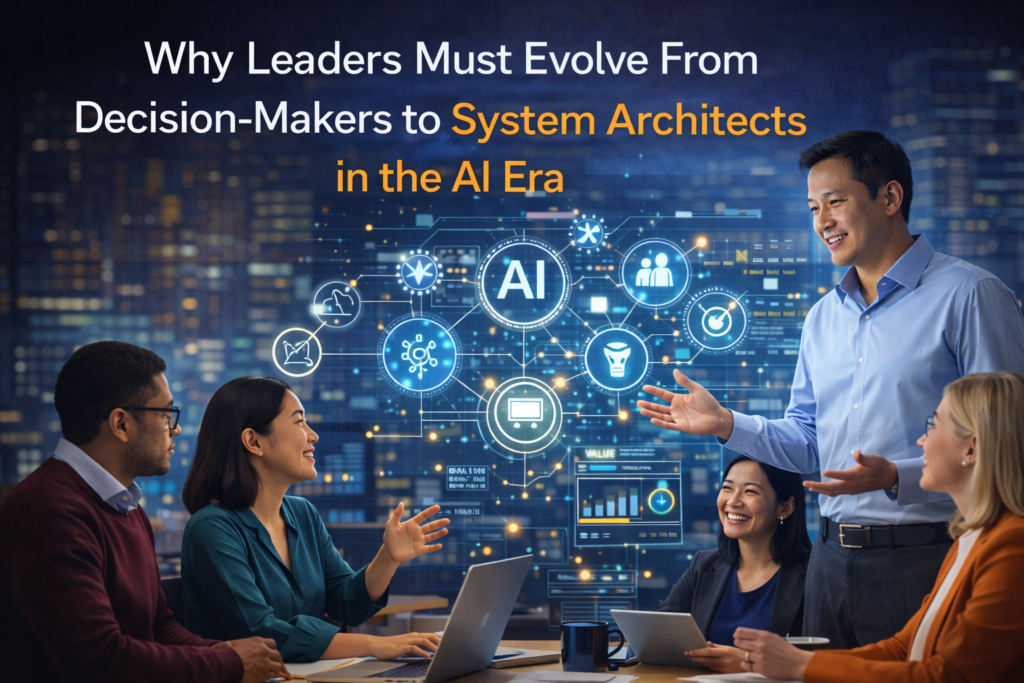
In the AI era, leadership requires a fundamental shift toward systems thinking rather than isolated decision-making, as traditional leadership models are no longer sufficient to navigate digital transformation. Organizations often fail when leaders rely solely on vendors and tools without a structural understanding of how these elements integrate. To succeed, leaders must act as system architects—designing the synergy between people, processes, and technology—since workforce capability and execution alignment depend entirely on leadership clarity. Ultimately, future-ready organizations are those led by individuals who prioritize a deep understanding of integrated systems over mere high-level strategy.
Introduction
For decades, leadership followed a simple model.
Leaders:
- Made decisions
- Delegated execution
- Relied on specialists
And this worked.
But today, in the age of AI and Digital Transformation,
this model is no longer enough.
Because the complexity of modern organisations has changed.
Leaders are no longer just decision-makers.
They must become system architects.
And those who fail to evolve will struggle—not because they lack intelligence,
but because they lack structural understanding.
The Current Problem
Most leaders still operate with an outdated identity.
They believe their role is to:
- Approve strategies
- Select vendors
- Monitor performance
But in reality, this creates a dangerous gap.
The Hidden Risk
Leaders become:
- Dependent on external advice
- Disconnected from execution
- Reactive instead of strategic
What This Looks Like
- Vendor-Driven Decisions
Technology direction is influenced by providers—not internal clarity. - Fragmented Systems
Different departments adopt tools independently. - Low Execution Visibility
Leaders cannot see how work actually happens. - Misaligned Workforce
Teams do not understand how their work connects to strategy. - Delayed Transformation
Decisions are made—but results are slow.
The result?
 Leadership exists
But control is lost
The Strategic Framework
To lead effectively in the AI era, leaders must evolve into System Architects.
Here are 5 critical shifts:
1. From Decision-Making → To System Design
Leaders must define:
- How work flows
- How decisions are made
- How systems interact
2. From Delegation → To Understanding
Leaders don’t need to code.
But they must understand:
- Workflow logic
- System dependencies
- AI impact on operations
3. From Tools → To Structure
Instead of asking:
“What tools should we use?”
Ask:
“How should our organisation operate?”
4. From Control → To Alignment
System Architects align:
- People
- Processes
- Technology
Into one coherent system.
5. From Static Leadership → To Adaptive Leadership
Leaders must continuously:
- Learn
- Adjust
- Redesign
Because transformation never stops.
Deep Breakdown
Why Decision-Making Is No Longer Enough
In the past:
Decisions drove results
Today:
Systems drive results
Because once systems are in place:
They operate continuously
The Power of System Thinking
System Architects see:
- How one decision affects multiple areas
- How workflows interact
- Where inefficiencies exist
This allows them to:
Solve problems at the root
Leadership Is Now the Limiting Factor
Technology is available.
Tools are accessible.
But organisations still struggle.
Why?
Because leadership has not evolved
Strategic / Business Implications
For SMEs
SME leaders must:
- Understand their operations deeply
- Design efficient workflows
- Align teams with execution
Otherwise:
Growth becomes chaotic
For HR Leaders
HR must support leadership evolution by:
- Developing system thinking
- Aligning workforce with workflows
- Building execution capability
For Corporate Decision-Makers
The biggest shift is this:
Leaders are no longer just decision-makers
They are system designers
Without this shift:
- Transformation slows
- Systems fail
- ROI drops
Ecosystem / Industry Direction Layer
Leaders do not become System Architects in isolation.
They evolve through:
- Exposure to different industries
- Observing real implementations
- Engaging with ecosystems
Because:
Perspective shapes thinking
And thinking shapes systems.
Organisations connected to the right ecosystem:
- Learn faster
- Adapt faster
- Execute better
FAQ
1. What is a System Architect leader?
A leader who designs how people, processes, and technology work together.
2. Do leaders need technical knowledge?
Not deeply—but they must understand systems and workflows.
3. Why is this important in AI adoption?
Because AI impacts how work is structured—not just what tools are used.
4. Can traditional leadership still work?
Only to a limited extent. It struggles in complex, fast-changing environments.
5. What is the biggest leadership risk today?
Remaining a decision-maker when the role now requires system design.
Conclusion
Leadership is evolving.
The question is not whether organisations will adopt AI.
They will.
The real question is:
Will leadership evolve fast enough to manage it?
Because in the AI era:
The best leaders are not those who decide better.
They are those who design better systems.
And those who fail to evolve…
Will slowly lose control over their own organisation.