
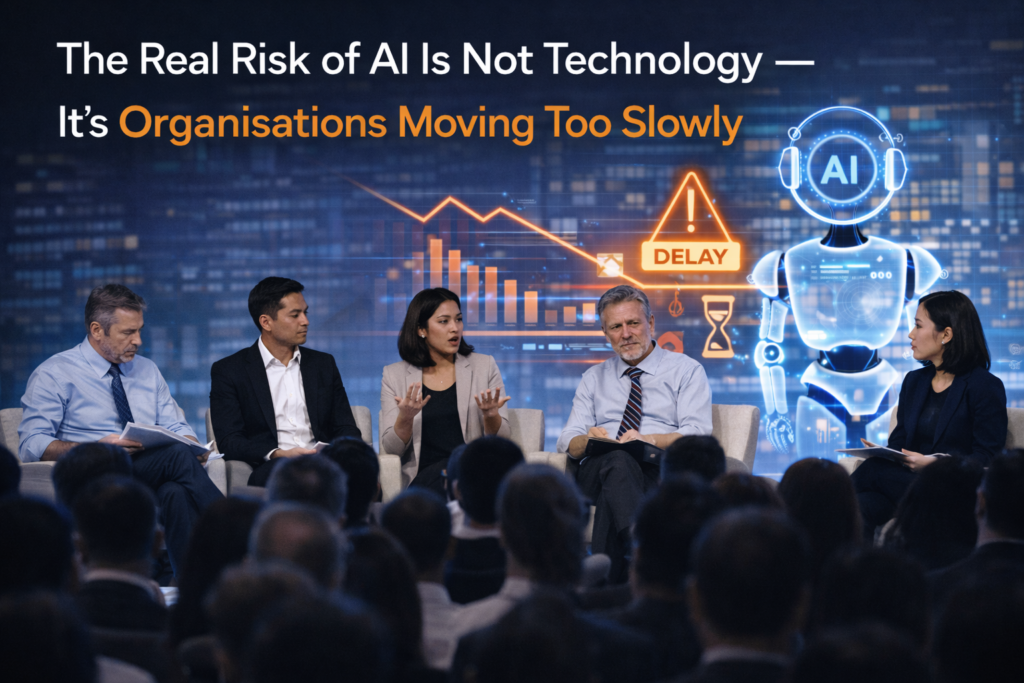
The core risk in AI adoption isn’t failure, but slow progress; while many organizations believe they are transforming, they are often moving far behind their competitors. Because AI and digital transformation reward speed over perfection, slow decision-making creates an invisible, long-term competitive loss that is difficult to recover from. When workforce misalignment and unclear execution reduce the ROI of AI investments, the advantage goes to those who move faster—even if they move imperfectly—as they gain an exponential advantage over the rest of the market.
Introduction
Most organisations today are doing something about AI.
They are:
- Exploring tools
- Attending workshops
- Running pilot projects
On the surface, it looks like progress.
But here is the uncomfortable truth:
The real risk of AI is not failure.
It is moving too slowly.
Because in today’s market, transformation is not judged by intention.
 It is judged by speed of execution.
And while some organisations are still preparing,
others are already scaling.
The Current Problem
Many companies believe they are on the right track.
They say:
- “We are in progress”
- “We are evaluating options”
- “We are planning carefully”
But beneath this confidence lies a dangerous reality.
The Hidden Problem: Slow Transformation
- Over-analysis Instead of Action
Too much time spent planning, too little executing. - Fragmented AI Adoption
Different teams experimenting without alignment. - Lack of Urgency
No clear pressure to move faster. - Delayed Workforce Readiness
Teams are introduced to AI—but not trained to execute with it. - No Execution Timeline
Projects stretch without measurable outcomes.
The result?
Organisations feel safe…
But are actually falling behind.
The Strategic Framework
To compete in the AI economy, organisations must shift from cautious progress to structured speed.
Here are 5 key drivers:
1. Speed Over Perfection
Waiting for the “perfect solution” creates delay.
In AI:
Imperfect execution beats perfect hesitation.
2. Clear Execution Timeline
Transformation must have:
- Defined milestones
- Measurable progress
- Accountability
3. Workforce Activation
AI tools alone are useless without:
- Practical training
- Real application
- Confidence in execution
4. Integrated Workflow Design
AI must be embedded into:
- Daily operations
- Decision-making processes
- Communication flows
5. Continuous Iteration
Transformation is not one-time.
It requires:
Test → Learn → Improve → Repeat
Deep Breakdown
The Illusion of Progress
Many organisations mistake activity for progress.
They:
- Attend sessions
- Test tools
- Discuss strategies
But nothing changes in:
Daily operations
This creates a false sense of movement.
The Cost of Moving Slowly
Slow transformation does not feel painful immediately.
But over time, it creates:
- Lost opportunities
- Reduced competitiveness
- Lower productivity
- Higher operational cost
By the time it is visible:
It is already too late
Speed Creates Compounding Advantage
Fast-moving organisations gain:
- Early learning
- Faster adaptation
- Stronger positioning
This creates:
A widening gap
Because speed compounds over time.
Strategic / Business Implications
For SMEs
SMEs have a natural advantage: speed.
But without structure:
Speed becomes chaos
With proper execution:
Speed becomes dominance
For HR Leaders
The role of HR is evolving.
It is no longer about:
Delivering training
It is about:
Activating workforce capability
HR must ensure:
- AI readiness
- Practical execution
- Continuous development
For Corporate Decision-Makers
The biggest risk is not wrong decisions.
It is:
Slow decisions
Because competitors who move faster:
- Capture opportunities
- Build capability
- Strengthen position
Ecosystem / Industry Direction Layer
Forward-thinking organisations are not solving this internally.
They are:
- Learning from industry leaders
- Engaging in transformation ecosystems
- Gaining real-world exposure
Because:
Speed is not built alone
It is accelerated through exposure
Organisations connected to the right ecosystem:
- Move faster
- Decide better
- Execute stronger
FAQ
1. Is it better to move fast or be accurate in AI adoption?
Speed with iteration is more effective than waiting for perfection.
2. Why do companies move slowly in transformation?
Fear of failure, lack of clarity, and misaligned leadership.
3. How can organisations accelerate transformation?
By focusing on execution, workforce capability, and structured timelines.
4. Is slow progress really dangerous?
Yes. Because competitors are not waiting.
5. What is the biggest mistake leaders make?
Believing they have more time than they actually do.
Conclusion
The AI economy is not waiting.
It is already moving.
Some organisations are accelerating.
Others are still preparing.
And the difference between them is not intelligence.
It is speed.
Because in today’s world:
Moving slowly is no longer safe.
It is the biggest risk.
The real question is:
Are you moving fast enough…
or just moving comfortably?