
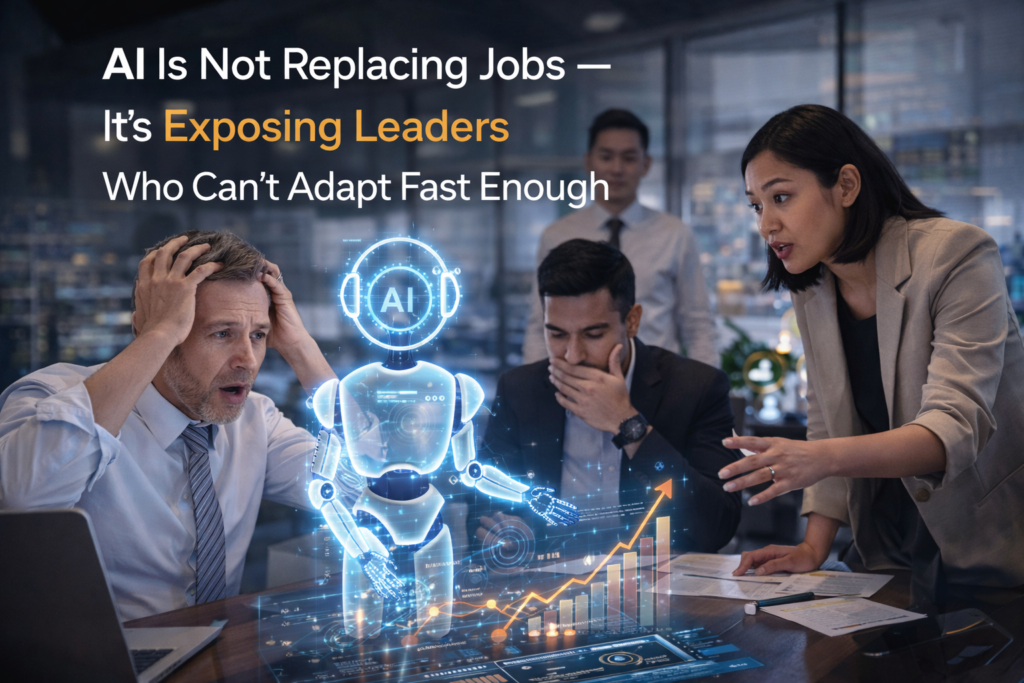
While AI often grabs the headlines, the primary disruption facing modern organizations isn’t the technology itself, but rather the speed and clarity of leadership. Companies frequently fail not due to a lack of tools, but because of slow decision-making and weak execution systems. True digital transformation requires a fundamental shift in leadership adaptation rather than simple technology adoption, especially as workforce capability gaps emerge as the primary bottleneck in implementation. Ultimately, those who successfully align their leadership, systems, and execution will rapidly outperform the market; the real risk is not being replaced by AI, but being overtaken by competitors who move faster than you.
Introduction
AI is everywhere.
From automation tools to predictive systems, organisations are rushing to adopt new technologies in the name of Digital Transformation.
But here is the uncomfortable truth:
AI is not replacing jobs.
It is exposing leaders who cannot adapt fast enough.
This shift is subtle—but dangerous.
Because while many organisations believe they are “progressing,” others are accelerating at a completely different speed.
And in today’s AI-driven economy, speed is no longer an advantage.
 It is survival.
The Current Problem
Most organisations think their challenge is technology.
They invest in:
- AI tools
- Automation platforms
- Digital systems
But still struggle with:
- Slow execution
- Confused teams
- Low ROI
Why?
Because the real problem is not technology.
It is leadership alignment and execution capability.
The Hidden Gaps
- Slow Decision-Making
Leaders hesitate, overanalyse, and delay execution. - Lack of Strategic Clarity
Teams adopt AI without clear direction or purpose. - Disconnected Workforce
Employees are exposed to tools—but not trained to execute with them. - No Execution System
Technology exists, but workflows are not redesigned.
The result?
Activity without outcome
Investment without return
The Strategic Framework
To lead in the AI era, organisations must shift from tool adoption to execution design.
Here are 5 critical pillars:
1. Leadership Speed & Clarity
Leaders must make faster, clearer decisions.
Not perfect decisions.
Decisive ones.
2. Workforce Capability Alignment
Employees must be trained to:
- Use AI tools
- Apply them in real workflows
- Deliver measurable results
3. Workflow System Design
AI must be embedded into:
- Daily operations
- Decision processes
- Communication flow
4. Execution Discipline
Transformation requires:
- Consistency
- Accountability
- Measurement
5. Continuous Adaptation
The market evolves constantly.
Organisations must:
Learn fast
Adjust fast
Execute faster
Deep Breakdown
Leadership Is Now the Bottleneck
In the past:
Technology was the limitation
Today:
Leadership is the limitation
Because tools are available to everyone.
But clarity?
Execution?
Speed?
Those are rare.
The Execution Gap
Most organisations sit here:
They know what to do
But cannot execute
This gap creates:
- Delays
- Confusion
- Missed opportunities
And over time:
Competitors move ahead
AI Amplifies Weakness
AI does not fix problems.
It amplifies them.
If your organisation is:
- Slow → AI makes inefficiency faster
- Disorganised → AI increases chaos
- Misaligned → AI creates inconsistency
Strategic / Business Implications
For SMEs
SMEs have speed advantage—but only if aligned.
Without execution systems:
Speed becomes chaos
With alignment:
Speed becomes dominance
For HR Leaders
HR is no longer just training.
It is:
Workforce transformation
This includes:
- AI readiness
- Capability building
- Behaviour change
For Corporate Decision-Makers
Technology is no longer a differentiator.
Execution is.
Without alignment:
- Investment fails
- Teams disconnect
- ROI drops
The real risk is thinking you are progressing when you are not.
Ecosystem / Industry Direction Layer
The smartest organisations are not solving this alone.
They are:
- Learning from industry peers
- Engaging in transformation platforms
- Exposing themselves to real-world execution
Because today:
Transformation is not internal
It is ecosystem-driven
Exposure accelerates:
- Learning
- Strategy
- Execution
FAQ
1. Is AI the biggest disruption today?
No. The biggest disruption is how leaders respond to AI.
2. Why do companies fail despite adopting AI?
Because they focus on tools instead of execution systems.
3. How can organisations improve execution?
By aligning leadership, workforce capability, and workflow systems.
4. Is workforce training enough?
No. Training must translate into real execution capability.
5. What is the biggest risk today?
Moving too slowly while competitors accelerate.
Conclusion
The AI era is not about technology.
It is about:
- Speed
- Clarity
- Execution
Some organisations are already moving ahead.
Others are still preparing.
And the gap between them is growing.
The real question is:
Are you adapting fast enough…
or just watching the market move ahead?