
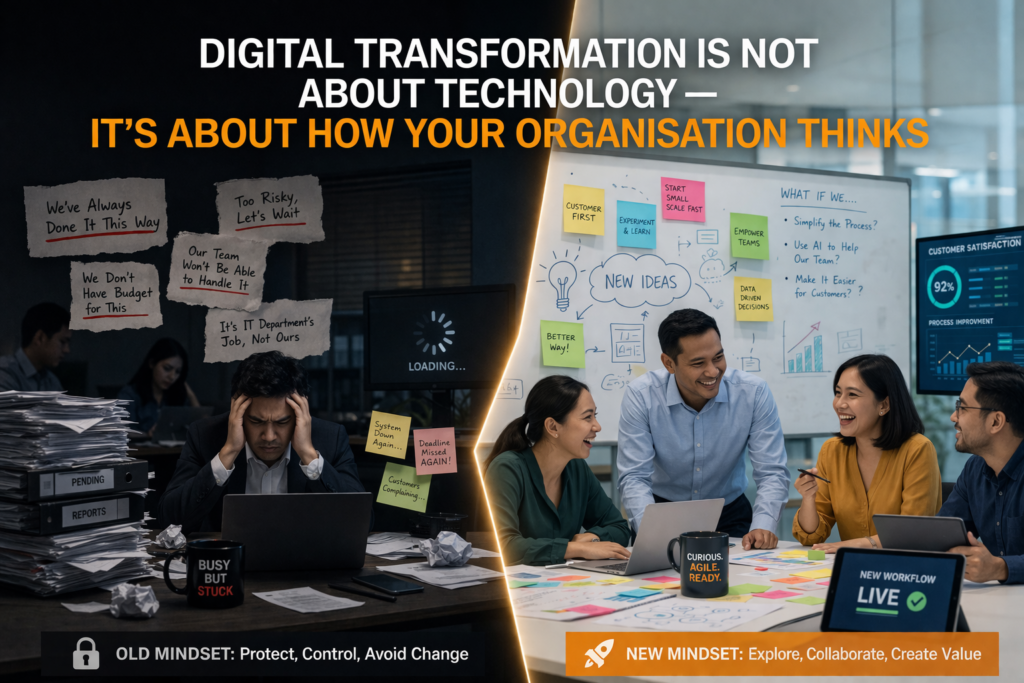
The success of Digital Transformation depends more on structured thinking than the technology itself, as most organizations fail by treating transformation as a mere tool selection problem. AI and digital systems only provide value when aligned with an organizational mindset and clear decision-making; therefore, prioritizing workflow thinking is far more critical than the specific software choice. To become future-ready, leaders must shift their focus from buying isolated solutions to designing integrated systems that ensure technology serves a clear, strategic purpose.
Introduction
When organisations talk about Digital Transformation,
the conversation almost always starts with technology.
ERP systems.
AI tools.
Automation platforms.
The assumption is simple:
 “If we choose the right system, everything will improve.”
But this assumption is fundamentally flawed.
Because the real driver of transformation is not technology.
It is how your organisation thinks.
And until this shifts,
no system—no matter how advanced—will deliver real results.
The Current Problem
Most organisations approach transformation like a shopping exercise.
They:
- Compare systems
- Evaluate features
- Select vendors
And expect outcomes to follow.
But in reality, they face:
- Low adoption
- Poor integration
- Limited ROI
Why?
Because they are solving the wrong problem.
The Core Mistake
Treating transformation as a technology decision
instead of a thinking and system design problem
What This Looks Like in Practice
- Tool-First Thinking
“What system should we buy?” - Vendor Dependency
Relying on external providers to define strategy. - Disconnected Decisions
Different departments adopting different tools. - No Workflow Redesign
Technology added on top of old processes. - Short-Term Implementation Focus
No long-term execution strategy.
The result?
Systems exist
But transformation does not
The Strategic Framework
To succeed in the AI era, organisations must shift from tool-focused thinking to system-focused thinking.
Here are 5 critical shifts:
1. From Tools → To Thinking
Before choosing technology, define:
- What problem are we solving?
- What outcome do we want?
- What must change operationally?
2. From Buying → To Designing
Transformation is not purchased.
It is designed.
Leaders must design:
- Workflows
- Decision processes
- System interactions
3. From Features → To Function
Focus less on:
What the system can do
Focus more on:
What the organisation must achieve
4. From Isolated Systems → To Integrated Workflows
Systems must connect across:
- Teams
- Processes
- Data flows
5. From Static Plans → To Adaptive Thinking
Transformation is continuous.
Organisations must:
Think → Test → Adjust → Repeat
Deep Breakdown
Why Thinking Determines Outcome
Technology does not fail on its own.
It fails because:
- It is used incorrectly
- It is implemented poorly
- It is not aligned with workflows
All of this comes back to:
Thinking
The Danger of Tool Dependency
Many organisations become dependent on:
- Vendors
- Consultants
- External solutions
Without internal clarity, they lose control.
And over time:
Decisions become reactive, not strategic
Workflow Is the Real System
Most leaders think:
Software = system
But in reality:
Workflow = system
Software is just a tool inside it.
Strategic / Business Implications
For SMEs
SMEs often choose systems based on:
- Cost
- Popularity
- Recommendation
But without workflow thinking:
Systems create more complexity
For HR Leaders
HR must align workforce with:
- New workflows
- New thinking
- New execution models
Training must evolve from:
Knowledge → to mindset shift
For Corporate Decision-Makers
The biggest shift is this:
Stop asking: “What system should we buy?”
Start asking: “How should our organisation operate?”
Because:
- Systems follow thinking
- Results follow structure
Ecosystem / Industry Direction Layer
Forward-thinking organisations are not learning in isolation.
They are:
- Observing how others design systems
- Learning from real implementations
- Engaging in industry ecosystems
Because:
Thinking evolves faster through exposure
Seeing different approaches:
- Expands perspective
- Improves decision-making
- Reduces costly mistakes
FAQ
1. Is technology still important in transformation?
Yes—but only when guided by clear thinking and system design.
2. Why do companies choose the wrong systems?
Because they focus on features instead of operational needs.
3. What should leaders focus on first?
Understanding workflows and defining desired outcomes.
4. Can good thinking improve poor systems?
Yes. But poor thinking will always fail—even with the best systems.
5. What is the biggest shift needed?
From tool selection to system design thinking.
Conclusion
Digital Transformation is not about technology.
It is about:
- Clarity
- Structure
- Thinking
Because in today’s AI-driven economy:
Tools are everywhere
Systems are rare
And the organisations that win are not those with better tools.
They are those with:
Better thinking
The real question is:
Are you upgrading your systems…
or upgrading how your organisation thinks?